
Summer Fiesta Chess Camp - 7/25/2026
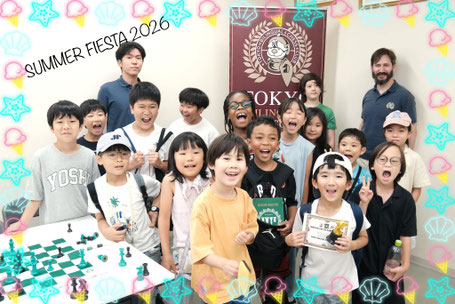
Got on board! The Tokyo Bilingual Chess School's Summer Fiesta Chess Camp was held on July 25, 2026 as We had 19 students in total who all enjoyed a combination of classroom instruction and playing chess, as well as fun outdoor time with the lunch and snack time! Brains were buzzing, strategy was on point, and every match was intense.
Players were divided into three groups of similar strength to maximize the learning experience.
Each group had sessions with different instructors.
WORLD POPULATION TOURNAMENT
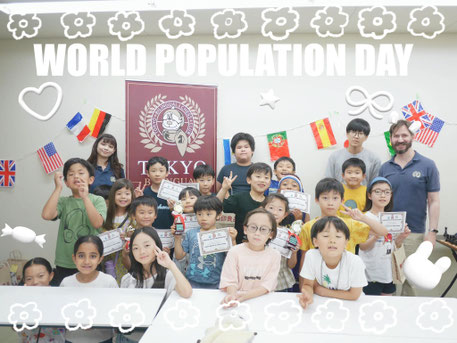
The Tokyo Bilingual Chess School's World Population Tournament attracted 23 of the best scholastic players in the central Tokyo area. Deep thinkers attend this tournament from grades one up through 8th grade to compete against the strongest competition scholastic chess has to offer. Several students in Class A were one of talented youngsters rated over the 1500 mark in the Japan Chess Federation.
🌟 OUR VISION🌟
Prestige & Family: Our Deep-Rooted Story
🍁Our Roots: A Legacy of Excellence and Close-Knit Community
Tokyo Bilingual Chess School was born from the chess club at Nishimachi International School—an institution renowned for its prestigious reputation, rigorous standards, and exclusive learning environment. We are not just a school; we are a curated community. Embracing Nishimachi’s cherished philosophy, we maintain small class sizes where elite instructors and students connect like family. Here, your child does not just learn chess—they gain entry into a prestigious, supportive, and truly international family.
🍂Inspired by the Spirit of Nishimachi’s Founder, Tane Matsukata
When Tane Matsukata founded Nishimachi, she envisioned a place where language and cultural barriers would vanish, creating a warm, nurturing environment where every child was valued as family. It is this exact visionary spirit that inspired the creation of the Tokyo Bilingual Chess School.
Our chess community is built on that very same foundation. To us, chess is more than a game of strategy; it is a bridge that connects us. We have intentionally built a selective, tight-knit family where our children, our elite masters, and our dedicated parents all share a deep, supportive bond. We do not just teach chess—we carry forward a legacy of heart, prestige, and global community, welcoming those who seek a truly meaningful and exclusive educational family.
The Thinking Curriculum
We believe that children flourish best in an environment that is both nurturing and challenging. Chess is our thinking curriculum, intentionally guiding students to develop:
♖ Strategic and analytical thinking
♖ Creativity and problem-solving
♖ Focus, memory, and decision-making
♖ Emotional maturity and sportsmanship
♖ Bilingual communication skills
Cultivating Global Thinkers
Our ultimate vision is to cultivate a selective group of students who:
♘ Think deeply and act thoughtfully
♘ Approach challenges with curiosity and resilience
♘ Communicate confidently across languages and cultures
♘ Contribute positively to their communities and beyond
At Tokyo Bilingual Chess School, we strive to create an exclusive sanctuary where every learner feels supported, inspired, and empowered—developing the skills, mindset, and character to thrive in chess, in school, and in life.
💡WHY DO WE DO IT?💡
My son enjoyed his K-5 elementary school chess club in Tokyo. He was really looking forward to playing the chess club champions from the other international schools at the upper elementary chess club. Then, before the summer break, we learned the bad news. The majority of international schools had no chess club for elementary students in Tokyo to experience the benefit of chess. I started to speak with the school principal, teachers, students and parents.
Afterward I wondered, "could a parent with no expertise in chess start a chess tournament at the Nishimachi International School in Tokyo???" After all, I'm barely a good match for my 6 year old son! As it turns out, there were some helpful web sites indicating, this is indeed possible! But, how? A couple of the sites even provided general descriptions of the process of starting a scholastic chess tournament. However, none gave a good detailed blow-by-blow description of the process with actual requirements, all the necessary documents and materials to pull it off. I needed a scholastic chess tournament start-up do-it-yourself kit for dummies. But, none existed.


It was hard to put the idea of starting a chess tournament aside, in spite of my ignorance on the subject. My son and a lot of other kids in Tokyo Bilingual Chess School stood to benefit a lot from the effort.
There will be still a lot of details to sort out and materials to prepare for our tournaments and events.
Let us try! And then try again! Hang in there!
SUMMER PROGRAM

FUN TOURNAMENTS

ADOPT A SCHOOL


